Policy 1
Citizenship and passport applicants
Background
Vanuatu passports can only be issued to Vanuatu citizens. Passport applicants must complete the citizenship declaration on the application form.
Policy statements
Citizenship categories
Under legislation, entitlement to a Vanuatu passport (as a citizen) broadly falls into three categories:
1. Born after 30 July 1980, with at least one parent that was a Vanuatu citizen at the time of birth.
2. Born on or before 30 July 1980 and of indigenous ni-Vanuatu ancestry.
3. Citizen by naturalisation (granted by the Citizenship Commission after 30 July 1980)
Supporting documents to establish citizenship
All passport applicants need to provide an original birth certificate.
Category 1
| If…. |
And... |
Then…. |
| Applicant born in Vanuatu after 30 July 1980 |
Applicant has one parent of indigenous ni-Vanuatu ancestry |
Applicant must provide original Vanuatu birth certificate showing at least one parent of indigenous ni-Vanuatu ancestry |
| Applicant born overseas after 30 July 1980 |
Applicant has one parent of indigenous ni-Vanuatu ancestry |
- Applicant must provide original birth certificate showing at least one parent of indigenous ni-Vanuatu ancestry.
- With an overseas birth certificate, the parent's birth certificate must be provided to establish the parent's ni-Vanuatu ancestry.
|
| Applicant born in Vanuatu after 30 July 1980 |
Applicant has at least one parent who was a Vanuatu citizen by naturalisation at the time of the applicant's birth |
- Applicant must provide original Vanuatu birth certificate showing at least one parent who is a Vanuatu citizen, and
- proof of the parent's citizenship (i.e. Vanuatu Citizenship Certificate).
|
| Applicant born overseas after 30 July 1980 |
Applicant has at least one parent who was a Vanuatu citizen by naturalisation at the time of the applicant's birth |
- Applicant must provide original birth certificate showing at least one parent who is a Vanuatu citizen, and
- proof of the parent's citizenship (i.e. Vanuatu Citizenship Certificate).
|
Category 2
| If… |
And... |
Then… |
| Applicant born in Vanuatu on or before 30 July 1980 |
Applicant is of indigenous ni-Vanuatu ancestry |
Applicant must provide original Vanuatu birth certificate showing at least one parent of indigenous ni-Vanuatu ancestry |
| Applicant born overseas on or before 30 July 1980 |
Applicant is of indigenous ni-Vanuatu ancestry |
- Applicant must prove that they were not a citizen of their country of birth on 30 July 1980, and
- that they have or had four grandparents who belong to a tribe or community indigenous to Vanuatu, or
- that an application was made for their Vanuatu citizenship within 3 months of 30 July 1980 (or within 3 months of reaching 18 years of age).
|
Category 3
| If…. |
And... |
Then…. |
| Applicant is a Vanuatu citizen by naturalisation (granted by the Citizenship Commission after 30 July 1980) |
Applicant is a citizen of no other country |
Applicant must provide
- Original birth certificate
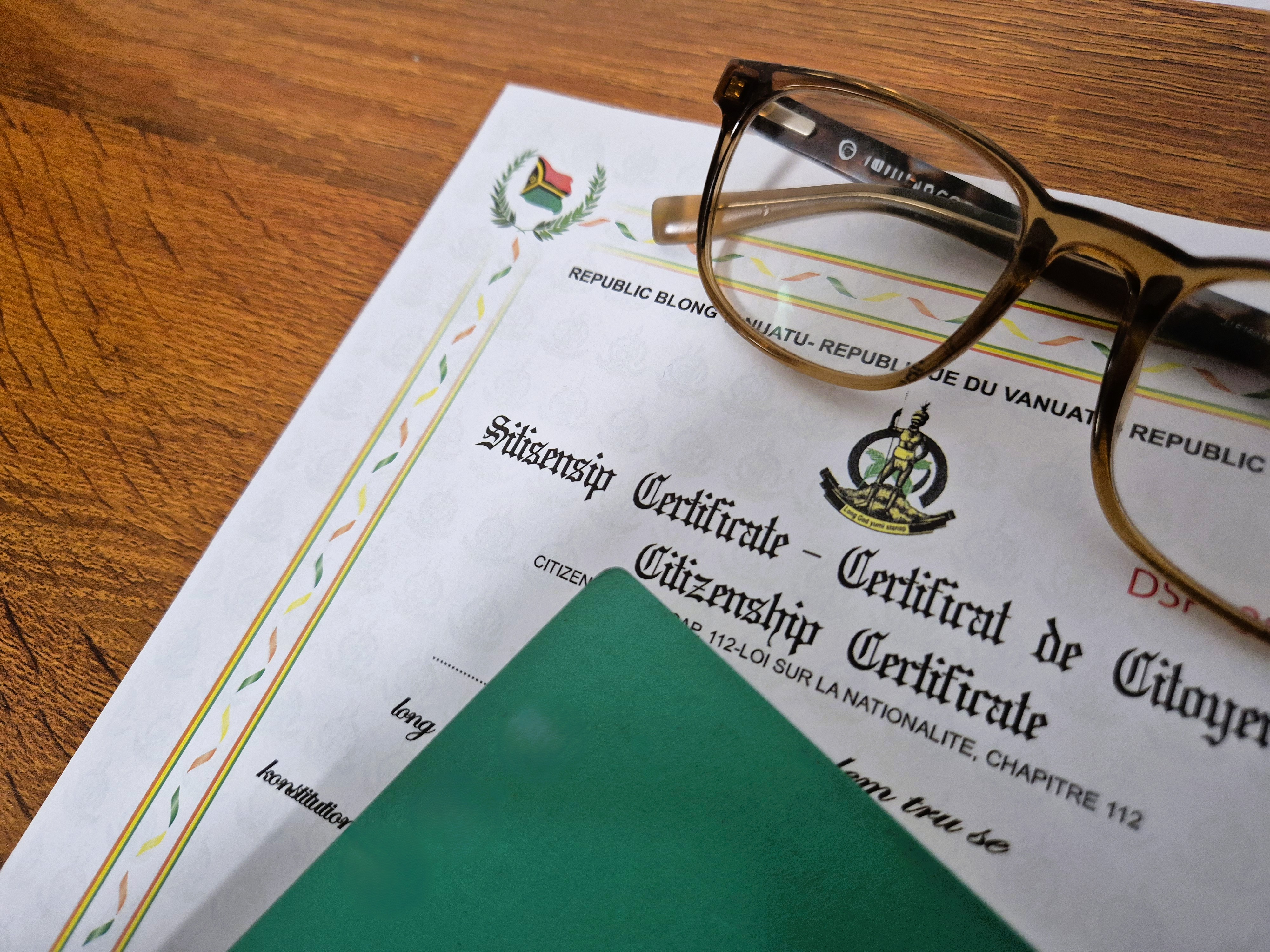
- Vanuatu citizenship certificate
- Details of previous nationality/ies
- Details of previous passport (if held)
|
Previous Vanuatu passports
Previous Vanuatu passports are not acceptable as evidence of entitlement to citizenship. Passport office will not assume that an applicant is a citizen if they have a previous Vanuatu passport. Entitlement to a passport will be checked for every application, and an original birth certificate provided.
Previous passports are submitted with applications so that they can be cancelled, and existing records can be linked to new applications for the same person.
If the previous passport is lost or stolen, a Police report is required and entitlement should be confirmed by looking up existing records.
Applicant not entitled to a passport
The Passport Office will refuse to issue a passport if the applicant is not a citizen. The Passport office needs to be confident in the applicant’s citizenship status, and be satisfied that the applicant is a citizen.
Passports may be cancelled if:
- The applicant has lost, been deprived of, or renounced Vanuatu citizenship
- The passport was issued to the holder in the mistaken belief that the holder was, at the time of issue, a citizen.
Entitlement Documents for Diplomatic and Official Passports
Applications for Diplomatic or Official passports require the same evidence of entitlement to citizenship as other passports. They must also provide a letter stating the reason they are entitled to a diplomatic or official passport.
Refer to Policy: Diplomatic and Official Passports
Legislation
Constitution of the Republic of Vanuatu, Chapter 3, Citizenship
Citizenship Act, Part 3 – Citizenship by Adoption and Naturalisation, Part 4 – loss and renunciation of and regaining citizenship.
Policy 2
Consent to issue a passport to a person under 18 years of age
Background
Applicants not yet 18 years of age, who are ni-Vanuatu citizens are issued with their own passports.
Vanuatu citizenship requirements
All applicants not yet 18 years of age applying for a passport must have Vanuatu citizenship.
The citizenship status must be confirmed by the citizenship office, and documentary evidence is required.
Policy statements
General
Passports will only be issued to a person under the age of 18 years, where one of his or her parents, or legal guardians, has given consent in writing.
Applicants where consent has not been given by one of his or her parents, or legal guardians, will not be issued with a passport.
Consent of parent
A child is defined as being under the age of 18 years.
One parent must give consent in writing for a child’s passport to be issued.
The passport office will check the parent giving consent is named on the birth certificate, these must be consistent.
Consent of guardian
General
The consent for a child’s passport is given by a parent named on the birth certificate, or a guardian, who is not a natural parent of the applicant. The passport office will check the guardian
giving consent is the guardian of the child.
Documentary evidence of guardianship
When consent is given by a guardian, i.e. Chief or another person, a letter must be written to the Passport office.
The letter must state:
-
guardian’s name
-
guardian’s title
-
guardian’s contact details
-
guardian’s passport number (if held)
-
child’s name
-
a declaration he or she is the guardian of the child
-
their relationship
-
how long the guardian has had care of the child applicant
-
why the written consent of a parent is not available
-
the length of time since the parent has been seen
-
the last known address of the parent
When a guardian other than the Chief is giving consent for the child’s passport, the letter must also include:
-
the chief’s name
-
the chief’s title
-
the chief’s contact details
-
the chief’s passport number(if held)
-
a declaration the person is the guardian of the child
-
the chief’s signature
Despatch of Child’s passport
Children’s passports may only be despatched to the parent or guardian and not to the child under 18 years of age. If a person other than the parent or guardian is collecting the passport, a letter from the parent or guardian must be provided giving authority for the other person to collect the passport.
Legislation(if required)
Passport Act 2009, Section 2(5), Issue of Vanuatu passports to children.
Policy 3
Date of Birth to be displayed on passport
Background
The applicant’s full date of birth is recorded in the passport system and printed on the bio data page of the passport.
Policy statements
The date of birth details on the application form must be consistent with the applicant’s birth certificate. Any variances must be referred either directly to the Civil Status Office or to the applicant, who may need to raise the issue with the Civil Status Office.
Policy 4
Documents provided by passport applicants
Background
All passport applicants must apply using the application form prescribed in regulations to the Passport Act 2009. Documents provided with the application form, including the birth certificate, are used to establish a person’s identity and entitlement to a passport.
Policy statements
Supporting documents
Passport office may request from the applicant:
- the supporting documents specified on the application form, and
- any further information they need to enable them to establish the person’s identity and entitlement to a passport. Examples:
- authenticated copy of overseas birth certificate
- confirmation of denial of citizenship from country of birth.
Documents provided by applicants, such as the birth certificate, are used to verify proper names, changes of name, date and place of birth. Passport officers must verify details against the original document, rather than relying on the application form.
Supporting documents must be original
All supporting documents provided with passport applications must be original.
Photocopies and facsimiles of documents provided by applicants are not acceptable for passport purposes These types of copies make it easier to submit a fraudulent application. For example, a photocopy or facsimile of an original document may be altered and photocopied again, which can then be presented as a photocopy of an original document. These alterations can be very difficult to detect.
Note: Some authorities (for example, the Civil Status Office), may issue certified photocopies as replacements. These are acceptable provided they bear the original seal or stamp of the issuing authority.
Unacceptable documents
Some records are not acceptable for confirmation of identity or entitlement details as part of a normal passport application. However, they may be used:
- to confirm or support any questionable information printed on a birth certificate, or
- as part of investigation to establish a person’s identity.
These records include:
- Church records
- Hospital records
- Foreign passports
- Damaged or altered documents. A document that has been significantly damaged or altered in any way is not acceptable. If an applicant provides a document that appears to be damaged or altered, the applicant must obtain a replacement from the issuing authority (for example, the Civil Status Office).
Legislation
Regulations to Passport Act 2009: Schedule 3.
Policy 5
Passport application fees.
Background
Passport application fees are to be set in regulations to the Passport Act 2009. The full fee for a passport application is payable at the time the application is lodged.
Purpose of Fees
The passport fee is designed to enable the Passport Office to:
- provide passports
- maintain the passport system over time
- provide advice and guidance to the public
- ensure that security processes are in place to maintain the integrity of, and international respect for, the Vanuatu passport.
Fees
The fees payable at the time of writing are as follows:
- Application for a normal passport: VT 5,000
- Application for an express passport: VT 7,000
- Application for a certificate of identity or travel document: VT 2,000
The fees payable in future are planned to be:
- Application for a normal passport: VT 7,000
- Application for an express passport: VT 10,000
- Application for an urgent passport: VT15,000
- Application for a certificate of identity or travel document: VT 7,000
- Children ( 0-3yrs):VT 1,500
- Children ( 4-6yrs):VT 2,000
- Children (7-17yrs): VT 3,000
- Urgent Application for Children: VT7,000
No fee is payable for diplomatic and official passports.
Policy statements
Fee waivers
There is no discretion to waive all of the fee described in the Regulations for an application for a normal passport. The base fee of VT 7000 must be paid for every application (except for diplomatic and official passports, where no fee is payable).
Policy 6
Fraud, forgery and counterfeit
Background
Fraud and forgery is most likely to come from applicants who are trying to secure financial benefit by presenting a false claim to Vanuatu citizenship, or from having one or more falsely obtained or invented Vanuatu identities.
Fraud Types
There are four main types of fraud of Vanuatu Passports:
- false passports/applications
- forged passports
- counterfeit passports
- false use of passports.
False passports and applications
A false passport is a genuine passport which has been obtained by false representation, and detected after issuance.
A false passport application is where the person is making an application in a false identity, which is detected before issuance.
Both scenarios generally involve using another person’s name and birth details, but the applicant’s own photographs, height and colour of eyes.
The most common method used to obtain false passports is by presenting another person’s birth certificate. The person may or may not be deceased but the birth certificate will often have been recently issued.
Other methods used to obtain false passports are:
- producing someone else’s passport in which the photo may or may not have been substituted (in support of with an application)
- Producing someone else’s citizenship certificate or letter of confirmation of citizenship declaring another person’s passport lost (often used by brothers).
Forged Passport
Forging passport details involves substituting photographs and or altering bio-data details on a genuine Vanuatu passport. It can also involve using either genuine blanks (printed with false identity information), or pages extracted from genuine passports.
The capture of travel movements by recording passport details electronically has lessened the usefulness of forged passports for border crossings in Australia and New Zealand where passports are likely to have been reported as lost or stolen.
Counterfeit
Counterfeit passports are created entirely, with no part of the physical document being genuine.
False Use of Passports
False use of genuine passports involves passports being used for movements by someone other than the holder. These movements could occur either as the result of an unreported theft of a passport, or the collusion of the passport holder with the illegal traveller.
Penalties
The penalties for fraud are found in the Vanuatu Passports Act. The offence provisions from the Act are listed in Appendix 1 of this policy document.
High Risk Applications
As stated earlier, fraud and forgery is most likely to come from applicants who are trying to secure financial (or other) benefits by presenting a false claim to Vanuatu citizenship, or from having one or more falsely obtained or invented Vanuatu identities.
High risk applications include:
- citizens who have been Naturalized under the Citizenship Act (where there is some suspicion legislative requirements for Citizenship have not been met)
- people who may have the ability to operate as dual nationals
- siblings/family members of a known criminal (may steal their identity to circumvent travel restrictions)
Any applications falling into the above categories should be referred to the Director of Immigration.
APPENDIX 1 Passports Act offences
False Vanuatu travel documents
A person commits an offence if he or she:
(a) makes a false Vanuatu travel document; or
(b) knowing a document to be a false Vanuatu travel document, without reasonable excuse:
(i) uses, deals with, or acts upon it as if it were genuine; or
(ii) causes another person to use, deal with, or act upon it as if it were genuine; or
(c) without reasonable excuse:
(i) has in his or her possession or under his or her control a document that he or she knows or has reason to suspect is a false Vanuatu travel document; or
(ii) sells, hires, lends, gives, or otherwise disposes of a document that he or she knows or has reason to suspect is a false Vanuatu travel document; or
(d) without lawful authority or reasonable excuse, makes or uses or has in his or her possession or disposes of any paper or other material that he or she knows is specially provided for any purpose relating to Vanuatu passport, certificate of identity or travel documents.
Making false or misleading statements
A person commits an offence if:
(a) the person makes a statement (whether orally, in writing or any other way) to another person that he or she knows to be false or misleading; and
(b) the statement is made in, or in connection with, an application for a Vanuatu travel document.
Improper use or possession of Vanuatu passport, certificate of identity or travel document
A person commits an offence if he or she:
(a) for purposes of travel and without reasonable excuse, uses a Vanuatu travel document, that he or she knows or has reasonable cause to suspect has expired or has been cancelled; or
(b) for purposes of travel or identification and without reasonable excuse, uses a Vanuatu travel document that he or she knows or has reasonable cause to suspect was issued to, or in respect of, another person; or
(c) being a person to whom a Vanuatu travel document has been issued, without reasonable excuse permits another person to have possession of that document in circumstances where he or she knows or has reasonable cause to suspect that the person intends to use it for purposes of travel or identification; or
(d) without lawful authority or reasonable excuse, takes or retains in his or her possession or under his or her control a Vanuatu travel document, against the will of the holder; or
(e) without reasonable excuse, has in his or her possession or under his or her control within Vanuatu:
(i) a passport issued by or on behalf of the Government of any country other than Vanuatu, being a passport that he or she knows or has reason to suspect has been falsified or has been obtained by false representation; or
(ii) a document purporting to be a passport issued by or on behalf of the Government of any country other than Vanuatu that he or she knows or has reason to suspect is not such a passport.
Unauthorised alteration, destruction or sale of Vanuatu travel document
A person commits an offence if he or she intentionally and without lawful authority:
(a) makes any alteration, addition, deletion or endorsement to a Vanuatu travel document; or
(b) destroys a Vanuatu travel document; or
(c) sells a Vanuatu travel document.
Offences relating to document information and material
Improper issue of documents
A person commits an offence if he or she, without lawful authority or reasonable excuse, issues a Vanuatu passport, certificate of identity or travel document (whether or not to the person to whom it relates) knowing that the person to whom it relates is not entitled to be issued it.
Failure to surrender document
A person commits an offence if he or she knowingly fails, without reasonable excuse, to comply with a demand to surrender a Vanuatu passport, certificate of identity or travel document to the Principal passport officer in accordance with subsections 9(2), 10(2) or 11(2).
Penalties
A person who commits any offence specified in sections 14 to 20 is liable on conviction to a term of imprisonment not exceeding 5 years or to a fine not exceeding VT5,000,000 or both.